Monday, May 14, 2012

Bombardier Aerospace & Products

Bombardier Aerospace is a division of Bombardier Inc. and is the third-largest airplane manufacturer in the world afterBoeing and Airbus. It is headquartered in DorvalQuebec, Canada.

History
After acquiring Canadair in 1986 and restoring it to profitability, Bombardier acquired in 1989 the near-bankrupt Short Brothers aircraft manufacturing company in Belfast, Northern Ireland. This was followed in 1990 by the acquisition of the bankrupt Learjet Company of Wichita, Kansas, builder of the Learjet business aircraft, and finally the money-losing Boeing subsidiary de Havilland Aircraft of Canada based in Toronto, Ontario in 1992.
The aerospace arm now accounts for over half of the company's revenue. Bombardier's most popular aircraft currently include its Dash 8 Series 400, CRJ100/200/440, and CRJ700/900/1000 lines of regional airliners. It also manufactures the Bombardier 415 amphibious water-bomber (in Dorval and North Bay), the Global Express and the Challenger business jet. Learjet is also a subsidiary of Bombardier based in Wichita, KS.
Bombardier had been in discussions with Mirabel, Quebec (near Montreal) and Kansas City, Missouri for a $375 million assembly plant, for its future Cseries aircraft, which Bombardier is marketing as a replacement for aging DC-9MD-80, and early, smaller versions of the Boeing 737. This new jet competes with the Boeing 737-600Boeing 737-700Airbus A318Airbus A319, and Embraer195. Bombardier claims the Cseries, which the company will offer in 110-seat and 130-seat versions, will burn at least 20% less fuel per trip than its "nearest" Embraer competitor and achieve "high 20s (percentage) savings" vs. the Boeing 737-600 or -700.
The launch customer for the C-series, Lufthansa, has signed a Letter of Intent for up to 60 aircraft and 30 options. The manufacturing complex in Montreal will be redeveloped by Ghafari Associates to incorporate lean manufacturing of its CSeries aircraft.
In March, 2011, The company obtained 50 firm orders and a further 70 optional order for jets from NetJets worth more than US$2.8 billion to US$6.7 billion, respectively.
Also in March 2011, Bombardier announced that it had signed a memorandum of understanding (MOU) with China's ICBC Financial Leasing to provide advance aircraft payment financing for Bombardier customers worth $8 billion.

Products
Business Jet

  • Bombardier Learjet 40 XR
  • Bombardier Learjet 45 XR
  • Bombardier Learjet 60 XR
  • Bombardier Learjet 70
  • Bombardier Learjet 75
  • Bombardier Learjet 85
  • Bombardier Challenger 300
  • Bombardier Challenger 30X
  • Bombardier Challenger 605
  • Bombardier Challenger 850
  • Bombardier Global family
    • Bombardier Global 5000
    • Bombardier Global 5000
    •  (with Global Vision Flightdeck)
    • Bombardier Global 6000
    • Bombardier Global 7000
    •  Entry into service 2016[10]
    • Bombardier Global 8000
    •  Entry into service 2017[10]
    Commercial jets
    • Bombardier CRJ100/CRJ200
    •  (50 passengers)
    • Bombardier CRJ700/CRJ900/CRJ1000
    •  (70-100 passengers)
    • Bombardier CSeries
    •  (100-149 passengers)
    Turboprops
    • Bombardier CL-215
    • Bombardier CL-415
    • DHC Dash 8/Bombardier QSeries

    Bombardier Dash 8 or Qseries

    Bombardier Q400 
    Role
    Narrow-body, turboprop airliner
    National origin
    Canada
    Manufacturer
    Bombardier Aerospace & de Havilland Canada
    First Flight
    June 20, 1983
    Introduction
    1984 with NorOntair
    Primary users
    Air Canada Jazz, United Express, Flybe, Horizon Air
    Produced
    1983-present
    Number built
    1,054 as of 2011
    Unit Cost
    Q200: US$13 million
    Q300: US$17 million
    Q400: US$27 million
    The Bombardier Dash 8 or Q-Series, previously known as the de Havilland Canada Dash 8 or DHC-8, is a series of twin-engined, medium range, turboprop airliners. Introduced by de Havilland Canada (DHC) in 1984, they are now produced by Bombardier Aerospace. Over 1,000 Dash 8s of all models have been built, with Bombardier forecasting a total production run of 1,192 aircraft of all variants through to 2016.
    The Dash 8 was developed from the de Havilland Canada Dash 7, which featured extreme short take-off and landing (STOL) performance. With the Dash 8, DHC focused on improving cruise performance and lowering operational costs. The engine chosen was the Pratt & Whitney Canada PW100. The aircraft has been delivered in four series. The Series 100 has a maximum capacity of 39, the Series 200 has the same capacity but offers more powerful engines, the Series 300 is a stretched, 50-seat version, and the Series 400 is further stretched to 78 passengers. Models delivered after 1997 have cabin noise suppression and are designated with the prefix, "Q". Production of the Series 100 ceased in 2005, and the Q200 and Q300 in 2009. Bombardier is considering launching a stretched version of the Q400.

    Variants 
    • Series 100


    DHC-8-100 series
    Original 37–39 passenger version that entered service in 1984. The original engine was the PW120A (CAA validated on December 13, 1985); later units used the PW121 (CAA validated on February 22, 1990). Rated engine power is 1,800 shp (1,340 kW).
    DHC-8-101
    1984 variant powered by either two PW120 or PW120A engines and a 33,000 lb (15,000 kg) takeoff weight.
    DHC-8-102
    1986 variant powered by either two PW120A or PW121 engines and a 34,500 lb (15,650 kg) takeoff weight.
    DHC-8-103
    1987 variant powered by two PW121 engines and a 34,500 lb (15,650 kg) takeoff weight (can be modified for a 35,200 lb [15,950 kg] take-off weight)
    DHC-8-102A
    1990 variant powered by two PW120A engines with revised Heath Tecna interior.
    DHC-8-106
    1992 variant powered by two PW121 engines and a 36,300 lb (16,450 kg) takeoff weight.
    DHC-8M-100
    Two aircraft for Maritime Pollution Surveillance, operated by Transport Canada, equipped with the MSS 6000 Surveillance system.
    CC-142
    Military transport version for the Canadian Forces in Europe.
    CT-142
    Military navigation training version for the Canadian Forces.
    E-9A
    A United States Air Force range control aircraft equipped with AN/APS-143(V)-1 radar that operates out of Tyndall AFB, Florida to ensure that the overwater military ranges in the Gulf of Mexico are clear of civilian boats and aircraft during live fire tests of air-launched missiles and other hazardous military activities. Two aircraft are assigned to the 82d Aerial Targets Squadron for the support of training missions.
    • Series 200


    DHC-8-200 Series
    Series 100 airframe with more powerful Pratt & Whitney Canada PW123 engines (rated at 2,150 shp or 1,600 kW) for improved performance also capable of carrying 37 to 39 passengers.
    DHC-8-201
    1995 variant powered by two PW123C engines.
    DHC-8-202
    1995 variant powered by two PW123D engines.
    Q200
    Version of the DHC-8-200 with the ANVS system.
    • Series 300


    DHC-8-300 Series
    Stretched 3.43 metres (11.3 ft) over the Series 100/200, a 50–56 passenger version that entered service in 1989. The Q300 is powered by the Pratt & Whitney PW123 or PW123B or PW123E, rated at 2,380-2,500 shp or 1,774-1,864 kW.
    DHC-8-301
    1989 variant powered by two PW123 engines
    DHC-8-311
    1990 variant powered by two PW123A engines with revised Heath Tecna interior.
    DHC-8-314
    1992 variant powered by two PW123B engines
    DHC-8-315
    1995 variant powered by two PW123E engines
    DHC-8-300A
    Version of the DHC-8-300 with increased payload.
    Q300
    Version of the DHC-8-300 with the ANVS system.
    DHC-8-300 MSA
    Upgraded variant with L3 for maritime surveillance platform.
    • Series 400
    Q400
    Stretched and improved 70–78 passenger version that entered service in 2000. Its 360 knot (667 km/h) cruise speed is 60-90 knots (111-166 km/h) higher than its competitors/predecessors. Powered by PW150A engines rated at 5,071 shp (3,781 kW) at maximum power (4,850 shp or 3,620 kW maximum continuous rated). The maximum operating altitude is 25,000 ft (7,600 m) for the standard version, although a version with drop-down oxygen masks is offered, which increases maximum operating altitude to 27,000 ft (8,200 m). All Q400s include the ANVS system.
    Q400NextGen
    Version of the Q400 with updated cabins, lighting, windows, overhead bins, landing gear, as well as reduced fuel and maintenance costs.
    Q400-MR
    2 Q400 adapted to the water bombing role by Cascade Aerospace for the French SĂ©curitĂ© Civile. The tanker mode can carry 2,600 US gallon of retardant, foam or water and travel at 340 knots.
    DHC-8-400
    1999 variant with a maximum of 68 passengers.
    DHC-8-401
    1999 variant with a maximum of 70 passengers.
    DHC-8-402
    1999 variant with a maximum of 78 passengers.
    DHC-8-402PF
    2008 converted pallet freighter variant with a payload of 9000 kg.
    DHC-8 MPA-D8
    2007 converted for use as a maritime patrol aircraft.

    Bombardier CRJ100series (CRJ100, CRJ200, CRJ440, Challenger, CRJ500)

     Bombardier CRJ100 (Lufthansa)
    Role
    Narrow-body jet airliner, regional jet/business jet
    National origin
    Canada
    Manufacturer
    Bombardier Aerospace
    First Flight
    May 10, 1991
    Introduction
    1992 with Lufthansa
    Status
    Out of production, in service
    Primary users
    SkyWest Airlines, Pinnacle Airlines, Express Jet, Comair
    Number built
    1,021 as of 2010
    Unit Cost
    US$24-39.7 million (2006)
    Variants
    Bombarider CRJ700/900/1000
    The Bombardier CRJ100 and CRJ200 are a family of regional airliner manufactured by Bombardier, and based on the Canadair Challenger business jet


    CRJ100The CRJ100 was stretched 5.92 meters (19 feet 5 inches), with fuselage plugs fore and aft of the wing, two more emergency exit doors, plus a reinforced and modified wing. Typical seating was 50 passengers, the maximum load being 52 passengers. The CRJ100 featured a Collins ProLine 4 avionics suite, Collins weather radar, GE CF34-3A1 turbofans with 41.0 kN (4,180 kgp / 9,220 lbf), new wings with extended span, more fuel capacity, and improved landing gear to handle the higher weights. It was followed by the CRJ100 ER subvariant with 20% more range, and the CRJ100 LR subvariant with 40% more range than the standard CRJ100. The CRJ 100 SE sub-variant was produced to more closely meet the needs of corporate and executive operators.


    CRJ200

    The CRJ200 is identical to the 100 model except for more efficient engines.
    Pinnacle Airlines had operated some with 44 seats, designated as CRJ440, with closets in the forward areas of the passenger cabin though these were converted to 50 seat airplanes. These modifications were designed to allow operations under their major airline contract "scope clause" which restricts major airlines' connection carriers from operating equipment carrying 50 or more passengers to guard against usurpation of Air Line Pilots Association and Allied Pilots Association pilots' union contract. Similarly, Comair's fleet of 40-seat CRJ200s were sold at a discounted price to discourage Comair from purchasing the less expensive and smaller Embraer 135.
    There is also a CRJ200 freighter version which is designated CRJ200 PF (Package Freighter) which was developed in cooperation with Cascade Aerospace on the request of West Air Sweden.

    Variants

    Several models of the CRJ have been produced, ranging in capacity from 40 to 50 passengers. The Regional Jet designations are marketing names and the official designation is CL-600-2B19.
    CRJ100 
    The CRJ100 is the original 50-seat version. It is equipped with General Electric CF34-3A1 engines. Operators include Jazz Aviation,Comair and more.
    CRJ200 
    The CRJ200 is identical to the CRJ100 except for its engines, which were upgraded to the CF34-3B1 model, offering improved efficiency.
    CRJ440 
    Certified up to 44-seat, this version was designed with fewer seats in order to meet the needs of some major United States airlines.
    Challenger 800/850
    A business jet variant of the CRJ200
    CRJ500 
    Proposed 50-seat version with wing and cabin improvements based on the CRJ700/900. Cancelled in 2001.

    Bombardier CRJ700 series (CRJ700, CRJ900, CRJ1000)

     Bombardier CRJ700 (Air France)
    Role
    Narrow-body jet airliner
    National origin
    Canada
    Manufacturer
    Bombardier Aerospace
    First Flight
    May 27, 1999
    Introduction
    2001
    Status
    In production, in service
    Primary users
    SkyWest Airlines, Pluna, ExpressJet, Mesaba Airlines
    Number built
    602 as of October 2011
    Unit Cost
    US$24-39.7 million (2006)
    Developed from
    Bombardier CRJ200
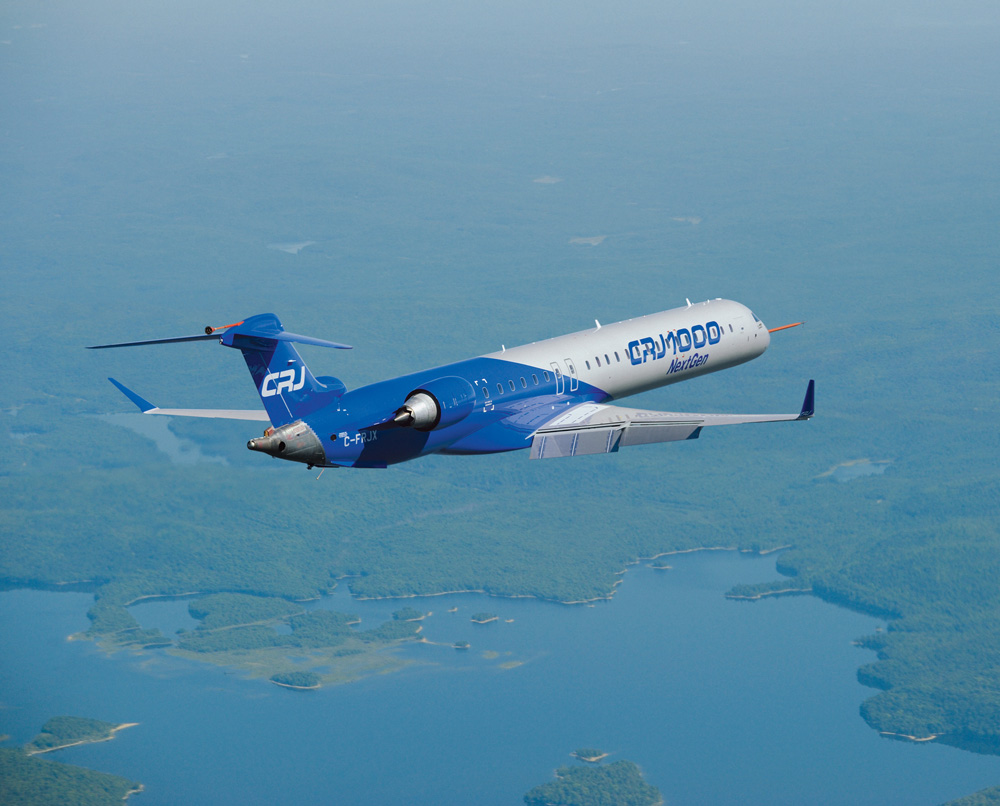
    The Bombardier CRJ700CRJ900, and CRJ1000 are regional airliners based on the Bombardier CRJ200. Final assembly of the aircraft is at MontrĂ©al-Mirabel International Airport in Mirabel, Quebec, outside MontrealCanada.
    CRJ700
    Design work on the CRJ700 by Bombardier started in 1995 and the programme was officially launched in January 1997. The CRJ700 is a stretched 70-seat derivative of the CRJ200. Seating ranges from 66 to 78 for the CRJ700 versions, however. The CRJ700 features a new wing with leading edge slats and a stretched and slightly widened fuselage, with a lowered floor.
    The aircraft is equipped with two General Electric CF34-8C1 engines. Maximum speed is Mach 0.85 (556 mi/hr, 895 km/hr) at a maximum altitude of 41,000 feet (12,500 m). Depending upon payload, the CRJ700 can travel up to 2,250 miles (3,620 km) with current engines, and a new variant with CF34-8C5 engines will be able to travel up to 2,895 miles (4,660 km).
    The CRJ700 comes in three versions: Series 700, Series 701, and Series 702. The 700 is limited to 68 passengers, the 701 to 70 passengers, and the 702 to 78 passengers. The CRJ700 also has three fuel/weight options: standard, ER, and LR. The ER version has an increase in fuel capacity as well as maximum weight, which in turn increases the range. The LR increases those values further. The executive version is marketed as the Challenger 870.
    Its first flight took place on May 27, 1999. The aircraft's FAA Type Certificate designation is the CL-600-2C10. The CRJ700 first entered commercial service with Brit Air in 2001.
    The CRJ700 directly competes with the Embraer 170, which typically seats 70 passengers.
    In 2008, the CRJ700 was replaced with the CRJ700 NextGen, featuring improved economics and a revised cabin common to the CRJ900 NextGen and CRJ1000 NextGen. In January 2011 SkyWest Airlines ordered four CRJ700 NextGen aircraft.
    CRJ900
    The CRJ900 is a stretched 76-90 seat version of the CRJ700. The aircraft features two GE CF34-8C5 engines, 13,360 lbf (59.4 kN) thrust with APR, and added leading edge slats. Max GTOW is 84,500 pounds. The airplane is loosely based on the CRJ200 series with a few major improvements. The environmental packs have a target temperature instead of a hot-cold knob. The cabin has a recirculation fan which aids in cooling and heating. The engines are controlled by FADEC digital engine control instead of control cables and a fuel control unit. The cabin floor has been lowered 2 inches which gains outward visibility from the windows in the cabin as the windows become closer to eye level height. The APU is a Honeywell RE220 unit which supplies much more air to the AC packs and has higher limits for starting and altitude usage. The wingspan is longer, the tail is redesigned with more span and anhedral. In typical service the CRJ900 can cruise 8-10,000 ft higher with a slightly higher fuel burn and an average true airspeed of 450-500 knots, a significant improvement over its predecessor. The FAA Type Certificate designation of the CRJ900 is the CL-600-2D24.


    CRJ1000


    On 19 February 2007, Bombardier launched the development of the CRJ1000, previously designated CRJ900X, as a stretched CRJ900, with up to 100 seats. Bombardier claims that it offers better performance and a higher profit per seat than the competing Embraer E-190.Brit Air and Air Nostrum are the launch customers for the CRJ1000. MyAir had ordered 15 CRJ900Xs that were converted to the CRJ1000, but the airline went bankrupt on 24 July 2009. Atlasjet also indicated interest in the new type.

    The CRJ1000 successfully completed its first flight in 2008. Bombardier, however, stated that the introduction into service had been delayed until the first quarter of 2010. On 14 June 2009 Bombardier announced a new firm order for 15 CRJ1000 NextGen aircraft placed by Air Nostrum, for a total of 35 CRJ1000 NextGen aircraft. There are 49 firm orders and 4 options for the variant as of August 2009.
    The variant completed its first production flight on 28 July 2009 in Montreal; the entry into service was planned then for the first quarter of 2010. A month after the first flight, however, a fault in the rudder controls forced the flight-test program to be grounded. The program was not resumed until February 2010, and deliveries were projected to begin by January 2011.
    Bombardier Aerospace announced on 10 November 2010 that its 100-seat CRJ1000 was awarded Aircraft Type Certificates fromTransport Canada and European Aviation Safety Agency, clearing the way for deliveries to begin. On 14 December 2010, Bombardier began CRJ1000 deliveries to Brit Air and Air Nostrum. On 23 December 2010 it was announced that the Federal Aviation Administration had also awarded a type certificate, allowing the CRJ1000 to operate in US airspace. The FAA Type Certificate designation of the CRJ1000 is the CL-600-2E25. In February 2012, Garuda Indonesia airline ordered six CRJ1000s and took options for another 18, and Danish lessor Nordic Aviation Capital ordered 12 for Garuda to operate with delivery beginning in 2012.


    Bombardier Cseries


    Bombardier Cseries
    Role
    Narrow-body jet airliner
    National origin
    Canada
    Manufacturer
    Bombardier Aerospace
    First Flight
    Slated for December 2012
    Introduction
    Slated for the end of 2013 (CS100)
    Status
    In development
    Unit Cost
    CS100: US$58.28 million
    CS300: US$66.57 million

    The Bombardier CSeries is a family of narrow-body, twin-engine, medium-range jet airliners being developed by Canadian manufacturer Bombardier Aerospace. Models are the 110-seat CS100, and the 130-seat CS300. These were initially named C110 and C130, respectively.
    The first flight was initially planned for the second half of 2012. In March 2012 Bombardier declared that the first flight is slated for December 2012. In February 2012, first delivery remains scheduled for the end of 2013.